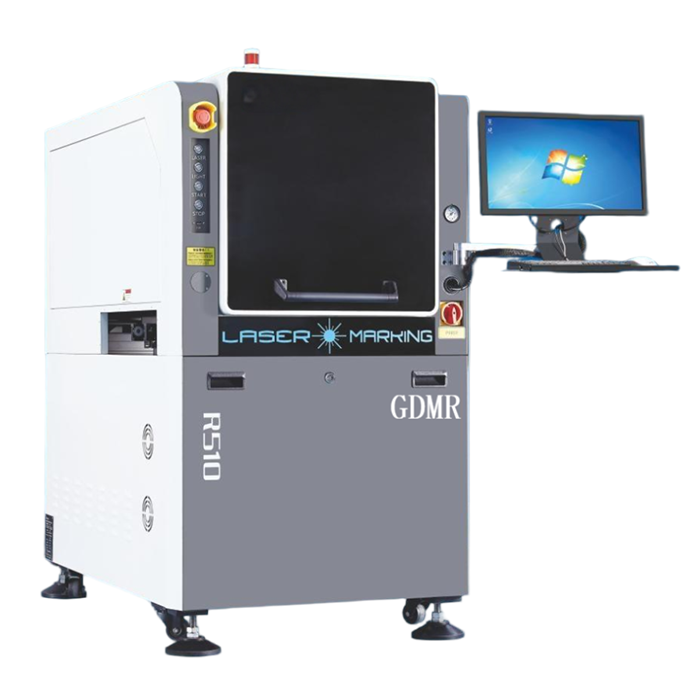
Choosing the appropriate laser marking equipment requires comprehensive consideration from seven dimensions: material compatibility, laser type, power and speed, equipment cost, software support, format and focal length, brand and service, as follows:
1、 Clarify material compatibility
The absorption characteristics of laser wavelengths vary significantly among different materials, and the laser type should be selected according to the processing object:
Fiber laser marking machine: wavelength 1.06 μ m, suitable for metals (stainless steel, aluminum alloy) and some hard plastics (ABS, PVC), with small spot size and high accuracy, but cannot effectively mark transparent materials.
CO ₂ laser marking machine: wavelength 10.6 μ m, specializing in non-metallic materials (wood, leather, acrylic, glass), with fast marking speed and low cost, but with a larger light spot and slightly lower accuracy than fiber laser.
UV laser marking machine: with a wavelength of 355nm, using "cold processing" technology, suitable for heat sensitive materials (PET, IC chips) and ultra-fine processing (micrometer level), but with low power and high cost.
Analysis: If metal parts need to be marked, fiber laser is preferred; If the processing object is plastic packaging or glass, CO ₂ laser is more economical; If you need to achieve micrometer level marking on the surface of electronic components, ultraviolet laser is the only option.
2、 Match laser type and processing requirements
Select equipment based on processing methods (carving, cutting, marking) and effect requirements (depth, clarity, speed):
Carving requirements: High power lasers (such as fiber lasers above 50W) are needed in conjunction with short focal length field mirrors to achieve deep carving effects.
Cutting requirements: Continuous wave laser (such as CO ₂ laser above 100W) and high-precision galvanometer are required to ensure smooth cutting.
Marking requirements: Select the laser type based on the material, such as fiber laser for metal marking, CO ₂ laser for non-metal marking, and ultraviolet laser for ultra-fine marking.
Analysis: If you need to engrave QR codes on metal surfaces, you need to choose a high-power fiber laser marking machine; If you need to cut patterns on glass surfaces, a CO ₂ laser cutting machine is more suitable; If you need to mark small characters on the surface of the chip, a UV laser marking machine is the only option.
3、 Balance power and speed
The power directly affects the marking speed and effect, and should be selected according to the production cycle:
Low power equipment (20W-50W): suitable for small batch processing or laboratory environments, with low cost but slow speed.
Medium power equipment (50W-100W): Balancing cost and efficiency, suitable for mass production in small and medium-sized enterprises.
High power equipment (above 100W): suitable for high-speed assembly line operations, but with high equipment and maintenance costs.
Analysis: If the production line has a pace of 30 pieces per minute, a medium power fiber laser marking machine should be selected; If the tempo increases to 100 pieces per minute, it needs to be upgraded to high-power equipment.