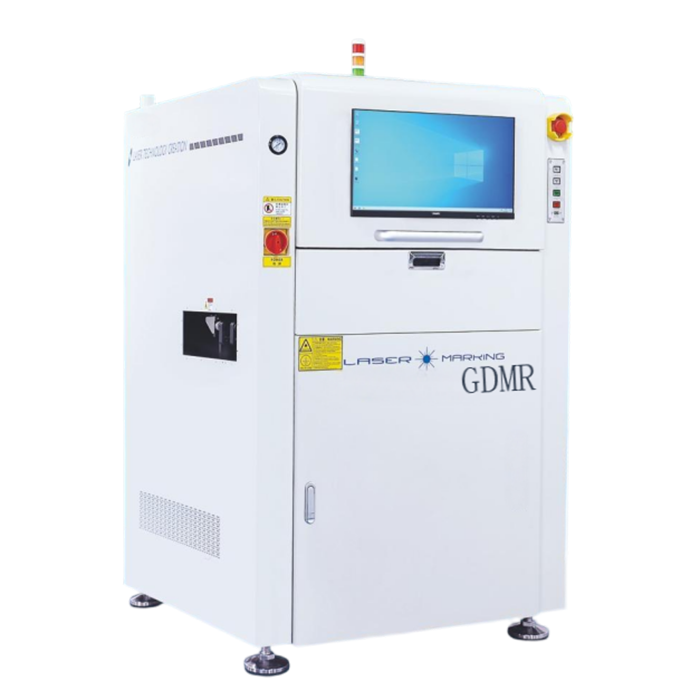
Laser marking equipment forms permanent marks on the surface of materials through high-energy laser beams, and is widely used in product identification, anti-counterfeiting traceability, and process decoration. To ensure stable operation of equipment, meet quality standards for labeling, and ensure operational safety, strict control is required from four dimensions: equipment selection, operation standards, maintenance, and environmental management. The following are specific precautions:
1、 Equipment selection and parameter matching
Laser type selection
CO ₂ laser: wavelength 10.6 μ m, suitable for non-metallic materials such as wood, leather, glass, but requires coating with additives when marking metals.
Fiber laser: with a wavelength of 1.06 μ m, it has high efficiency in marking metals (such as stainless steel and aluminum alloys), small heat affected zone, and is suitable for precision machining.
UV laser: wavelength 355nm, significant cold processing characteristics, suitable for thermosensitive materials such as plastics and ceramics, with no burrs on the marked edges.
Green laser: with a wavelength of 532nm, suitable for transparent materials such as glass and crystals, but the equipment cost is relatively high.
Power and field mirror matching
Power selection: determined based on material thickness and marking depth. For example, marking 1mm thick stainless steel requires a fiber laser of 20W or more; Mark the plastic film with a 5W ultraviolet laser.
Field lens focal length: Short focal length field lenses (such as 110mm) are suitable for small area high-precision marking, while long focal length field lenses (such as 160mm) are suitable for large area rapid marking.
Compatibility between galvanometer and software
Mirror speed: Choose a high-speed mirror (such as ≥ 3000mm/s) to improve marking efficiency, but it needs to match the laser pulse frequency to avoid missing marks.
Software function: Supports importing vector files such as DXF and PLT, with automatic typesetting, serial number generation, and anti-counterfeiting code encryption functions.
2、 Operating standards and safety protection
Personal Protective Equipment (PPE)
Laser protective goggles: Choose according to the laser wavelength (such as red lenses for CO ₂ laser and green lenses for fiber laser), with an OD value of ≥ 4, to prevent retinal damage.
Protective clothing: Wear flame-retardant and anti-static work clothes to avoid laser reflection burns to the skin.
Gloves: Use heat-resistant gloves (such as aramid material) to prevent contact with high-temperature workpieces.
Safety interlock system
Access control interlock: The laser is automatically cut off when the equipment door is opened to prevent accidental operation.
Emergency stop button: Install prominent emergency stop buttons on both sides of the console and equipment, with a response time of less than 0.1 seconds.
Key switch: Adopting dual key management, the operator and security officer jointly start the equipment.
Standardization of operating procedures
Sample testing: Before formal production, use waste materials to test the marking effect and adjust power, frequency, and speed parameters.
Workpiece fixation: Use specialized fixtures or vacuum suction platforms to avoid ghosting caused by workpiece movement during the marking process.
Defocus control: Adjust the height of the laser head according to the material characteristics, such as dynamically adjusting the defocus amount when marking curved workpieces.